In this month’s edition:
- Down on the farm 75 last month 3/25 – Tony Palmer
- Eastbourne Airshow Flying Line-up Announced
- Wheel reinvented (well, sort of)
- “Only Connect:” Adventures with Coaxial Plugs – Richard Griffiths
Down on the farm 75 last month 3/25
Klemm L25C G-ACXE
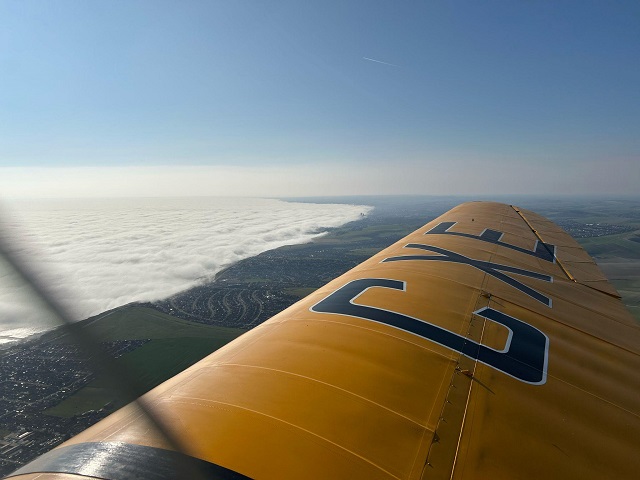
We managed to get some flights in to see if the oil reduction scheme has done any good and to check out the plane after the engine strip. I think we have a new one where we disturbed the inlet manifold and reduced the oil when we removed cylinder 3 so 2 steps forward and 1 back but a definite improvement.
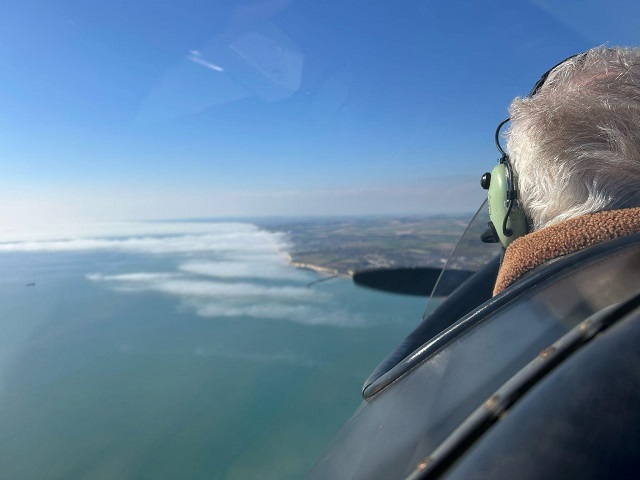
Prentice G-APPL VR189
I managed to pick up some rubber seals for the windows and some fireproof flat seals for around the cowl at the recent car restoration show at the NEC last Sunday. This entailed going around the North East section of the M25 as it was closed while they removed the old bridge near junction 11.
Bristell G-NGBB and DH82C
Not flown yet
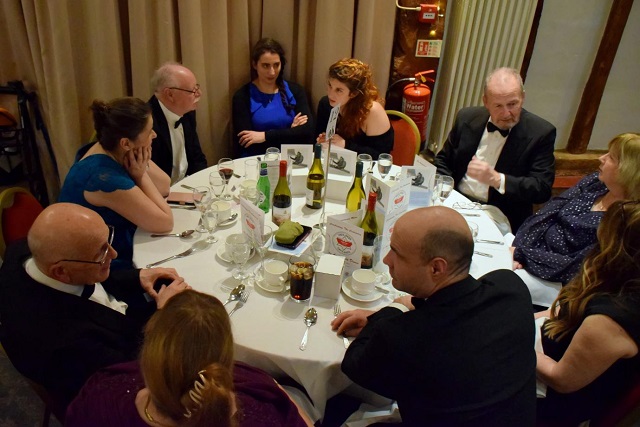
Moth centenary dinner
Out and About
I visited Kemble on Tuesday and spotted this Canberra parked up and the was a Gnat in front of the tower.
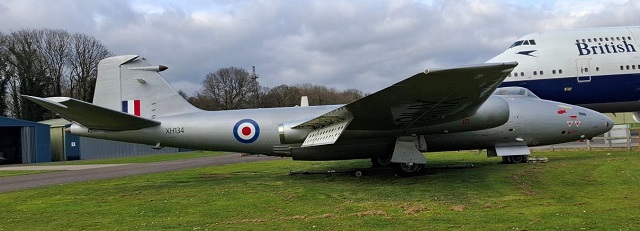
It’s of the same age as our Prentice but light years away in performance etc
Next club night April 2nd 2025
The club subscriptions will stay at £25 this year as it just covered the Xmas meal cost and will hopefully cover next years prices.
Please, PLEASE can we have club members come up with things to do this year!!! Maybe organise trips out to museums, flyouts, someone to do an interesting talk??
Tony Palmer
Eastbourne Airshow Flying Line-up Announced
A number of appearances have been confirmed including the Red Arrows (Thursday 14 August – Sunday), RAF Typhoon (Friday – Sunday), Battle of Britain Memorial Flight (Thursday – Sunday) and the unique Rich Goodwin’s Jet Pitts (Thursday – Sunday).
More will be added. Check here: visiteastbourne.com/airshow/flying/flying-line-up
Wheel reinvented (well, sort of)
Think you know how a gearbox works? Well prepare to have your mind blown by this new design. Tony Batchelar drew my attention to this company and the demonstration video on their website is fascinating. It’s an amazing example of rethinking a taken for granted device. Slightly annoying that the breakthrough comes in the twilight years of reciprocating power sources; electric motors won’t need it. However I guess it will be a while before it is not relevant. There’s an invitation to invest too. [Any investment is at your own risk and this is not to be construed as financial advice…]: https://ratiozero.com/
“Only Connect:”1 Adventures with Coaxial Plugs
The continuing saga of my SSDR panel upgrade, in which I attempt to master the intricacies of attaching a coaxial plug; an SMA connector to be precise. It may be that granny already knows what to do with this particular chicken product, but I didn’t. As it involves making electrical connections while performing a contortionist act under the panel, I though I should have a practice first. Turns out that was a Very Good Idea. I recorded the process to remind myself of the detail when I did it for real and thought it might be useful to someone else tackling what, on the (misleading) face of it is a trivial task.
I already had a TQ radio in the aircraft and am fitting a TQ transponder. The aerial attachment on the older radio is a substantial BNC connector. For some reason, then newer transponder has a much smaller SMA connector. The transponder aerial I got has a BNC mount on it, and fitting the corresponding connector on to the coaxial lead (once I managed to buy the correct one…) was straightforward. It’s the other end that is fiddly. With hindsight (isn’t that a wonderful thing) I should have fitted the SMA connector in the comfort of my home office before threading the cable through the airframe. Learning point 1: think things through in detail before starting!
Here are the components of the SMA connector:
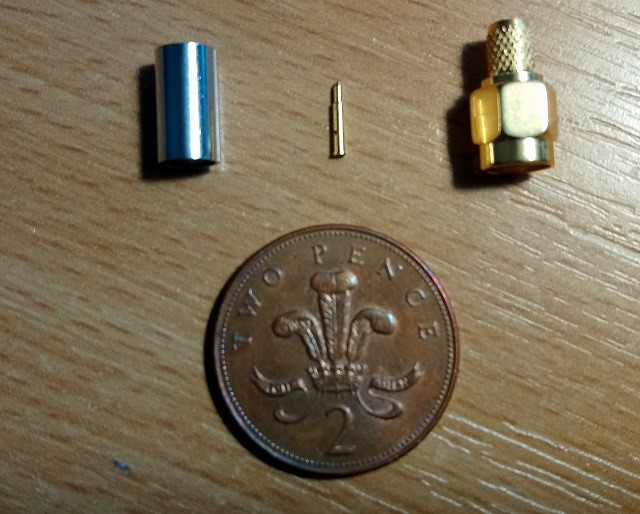
The idea is that the central wire of the coaxial cable goes into the pin that is located into insulation in the casing, the outer cable sheath lays over the knurled spigot and is crimped securely by the ferrule. The two-pence is to illustrate how bloody small the bits are! Not having the fingers of an elf, 100% I am going to loose that pin on the grass airfield. Learning point 2: get several components as backup (good for practice too). Actually the SMA connectors come in packets of 12 so that is taken care of.
So, to work. Learning point 3: IMPORTANT! First thing to do is to push the ferrule (and any additional sheath) onto the cable before doing anything else. Guess how I found that out… Then, remove the cable outer insulator a length just slightly longer than the connector body.
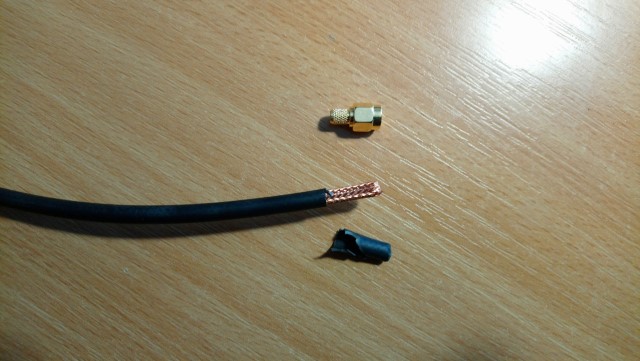
Next, comb out the braided outer conductor (a cocktail stick is handy for this) and unwrap the the inner copper foil.
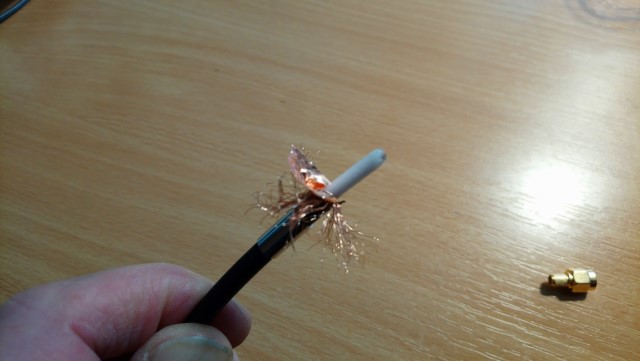
Strip the inner insulator back the body length. If the insulator was thinner, it could be left longer to fit into the hollow spigot, but the cable I had, pukka aviation aerial cable (Aeroflex 50-5 low loss – that’s the one the transponder supplier sent me), is too thick for that.
Now the really fiddly bit. The inner conductor has to be inserted into the pin. The hole is just perceptible without a magnifying glass, but only just. The multi-strand wire is too fat to fit, so I splayed out some cores until it did fit, then crimped it on. The unused wires from the core were wound around the base of the pin.
There is a whole extra story about getting a crimper. Farnell sell a range that go up to over £1K! Mine cost about £9 from AliExpress – it works, just about. If I made my living crimping plugs I might go for a more expensive one.
I popped an insulating sleeve over the twisted wires in case they uncoiled. The pin is then pushed into the housing, making sure that it protrudes the correct amount at the business end.
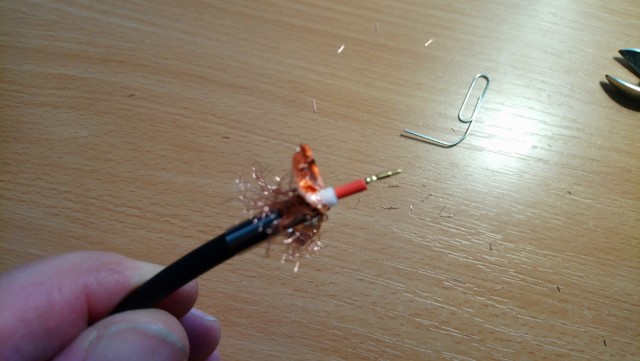
Next the foil and braid is wrapped over the knurled spigot. The idea is that the ferrule is pushed over to grip the braid before it is crimped. That is actually difficult and requires quite a bit of force. I put the connector face down on the desk and pushed the ferrule forcefully with a pair of pliers. In the field that would be difficult to do, so I made a tool; well I adapted the pliers by drilling a hole at the tip of one jaw.
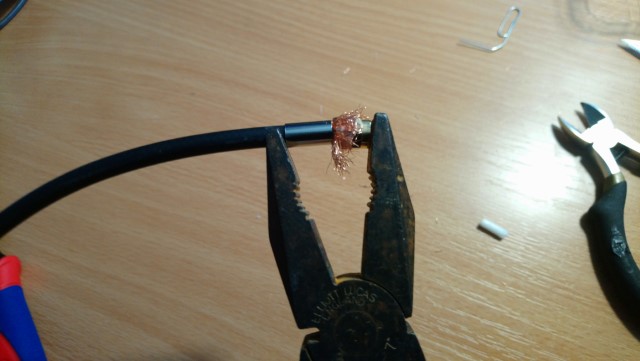
Once on, crimp the ferrule. I didn’t have a large crimp tool, so just used pliers that seemed to do the job; it’s certainly firmly attached. Trim off the excess braid, pop on a heat-shrink sleeve and Robert is your parent’s male sibling! Of course I tested for continuity and short-circuit too. That was the practice. Now to do it in the middle of a soggy field.
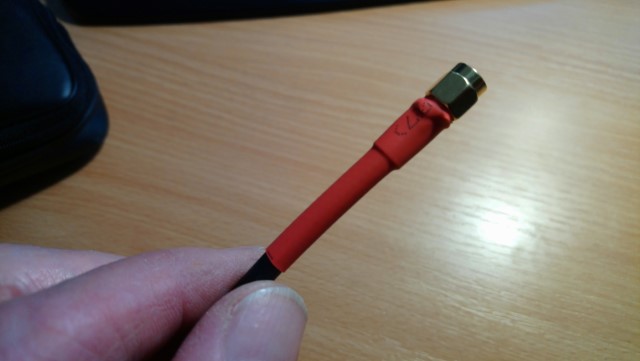
One final ‘elf-n-safety thing to watch out for: all the bits of very fine wire cut off in the process are like splinters. If you are not careful they get into your skin and are very annoying.
Post script: I managed to do the business in the field first attempt, and the transponder works. Phew!
If you have read this far and got something from this – my life is complete. Now you write up something you think my be helpful, or even interesting. 🙂
Richard Griffiths
- A phrase associated with E.M.Forster 1879 – 1970, from his novel ‘Howards End’, published in 1910. It has recently been adopted as the title of Victoria Coren Mitchell’s esoteric BBC quiz show. ↩︎
Events
Next Strut ‘Club Night’ at The Longshore is on Wednesday 2nd April, 7:30 pm.
For a full list of events go to the website Events page.
 Light Aircraft Association Southern Strut