In this edition:
- Down on the farm 80 last month 7/25 – Tony Palmer
- Shoreham Develops its own Flight Information Display
- Electric Aviation: This looks impressive
- Consultation on Electronic Conspicuity – Initial Technical Concept of Operations
- CAA Announce Cost Sharing Changes Coming into Force 1 October
- The Mysteries of Two-stroke Carburation – Richard Griffiths
- Bees bothering your pitot tube?
- Manston International Airshow Postponed to Next Year!
- Car Share to the LAA Leicester Rally
Down on the farm 80 last month 7/25
Klemm L25C G-ACXE

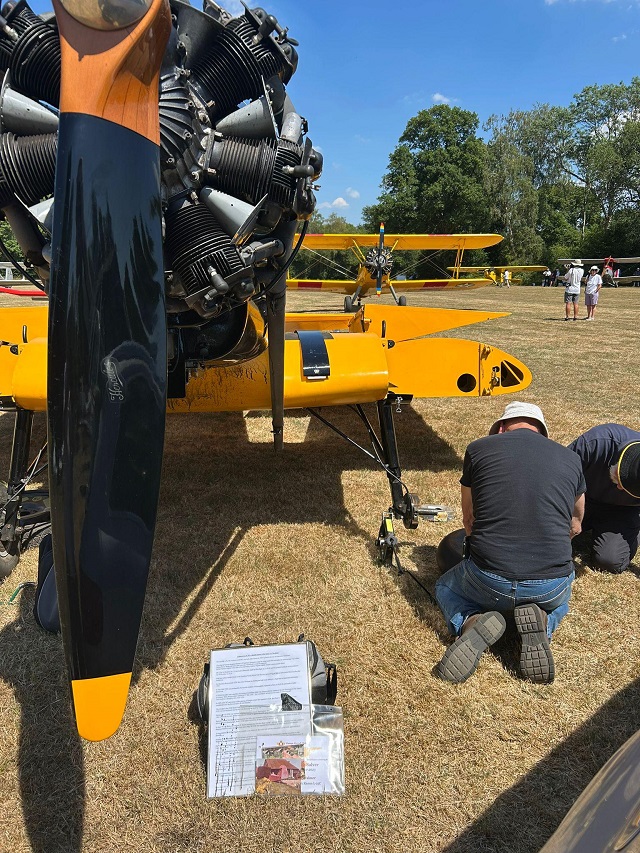
On the 12th of July we took XE to the fly-in at Tisted Farm. Jim flew down with Tony Berryman and I was due to fly back as I had driven down with my car as the backup vehicle, carrying tools fuel etc. They made it in about an hour, my journey was via Worthing hospital and with delays around Storrington it took me 3 hours. The weather was perfect and the planes on display were varied and generally of great interest. It was exceeding hot and Jim had folded the Starboard wing to display how it was done. Jim was standing by the other wing chatting to interested parties when there was a pop and the Port main tyre went very flat very quickly. Now this was going to be a problem because we had not brought a spare tube or tools to change it. We had the offer of gas cylinder with sealer but I thought the tube had ruptured completely and did not think it would work. Dave (RUG) who had organised the second Prentice for us was there in his Auster with tools in the back, so I rang him and he came up with a tube (wrong size) and levers. I used the levers to remove the tube which was U/S. At this stage a knight in shining armour, Ken Manley offered to take me home in his Jodel to fit the spare tube at home. We returned with the wheel with replacement tube and fitted it. We were about the last plane to go home that night. So thank you Rug, Ken and Jaqui for your help to get the plane flying during a very stressful few hours.

Prentice G-APPL VR189
We now have approval from the RAF/CAA to paint the plane in RAF colours and badges etc. After a fair bit of work we have managed to remove the propeller and the cowling. We have started work on cleaning up the engine and will take the prop to Deltair for an inspection before committing to the service it will need as if the blades are corroded beyond use then we will have to go to different blades.
Tiger Moth G-CFTK RCAF 5084
I have sold the plane, and it had to be delivered to Dunkerswell. This was pencilled in for the Monday after Tisted because the wind was due to be light but as Monday arrived it was high winds from the SW. I had been to Shoreham on the Sunday to buy fuel and we had decided to stop at Shoreham to fill up and take some pics in front of the 1930’s main building.
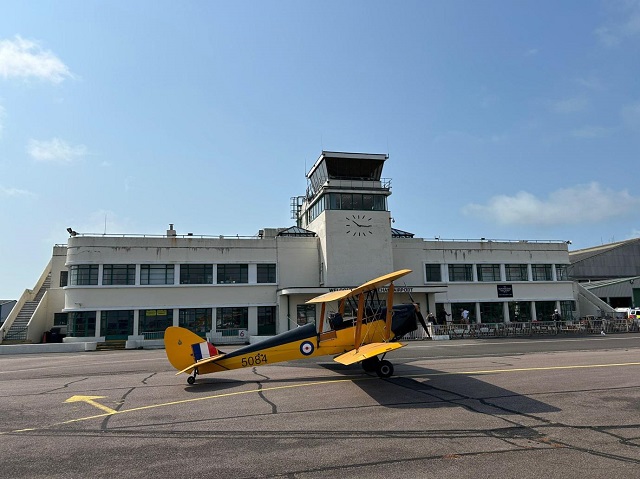
In a plane that cruises at 65 to 70 knots a 20kts headwind component tends to make the journey a long slog. The high winds apart from slowing us down made ground manoeuvring hard work and the flight also got bumpy at times. We left Shoreham and would have had a stop at Goodwood instead but as the Festival of speed was on the landing fees were astronomical, instead we went to Sandown and filled up and checked the oil. Then on to Henstridge where the landing was again perfect giving the demanding conditions. We parked near the fuel pump and a guy came out of a hanger and said “I thought I heard a Tiger land”. He was the guy that runs the Tiger training school there; he told me that all their planes were in the hangers as they could not operate in those conditions as they had no brakes. While we were talking to him the Tiger was blown backwards, so I ran around and put the brakes on, the into wind wing lifted so we put the nose directly into wind. Then the wheel on that side lifted of the ground so we decided to quickly refuel and take it over by the tower. I walked it over hanging onto the handle at the wingtip until we were in the lee of the building. Another short break and on again to Dunkerswell, we had a light shower but went around the dirty cloud generating it and eventually made it onto an into-wind hard runway as they don’t have any grass runways. It took more than 3 hours flying time and every minute was hard work. We were very glad to have completed it and we just got it into the hanger when it chucked it down.
The new owner has brought another Moth and will be doing air experience flights with them
Palmers Farm Fly-in Saturday 2nd August 2025
We will be having the annual Palmers Farm fly-in again this year on the 2nd of August, all are invited and Lesley will be providing the catering again this year.
Download information for arriving by land or air.
The Alvis club will be attending with a sample of motoring history.
Next Club Night August 2nd
The club subscriptions will stay at £25 this year as it just covered the Xmas meal cost and will hopefully cover next year’s prices.
Please, PLEASE can we have club members come up with things to do this year!!! Maybe organise trips out to museums, fly-outs, someone to do an interesting talk??
Tony Palmer
Shoreham Develops its own Flight Information Display
Brighton City Airport has announced the release of its new Aerium Flight Information Display (FID) system, which gained UK Civil Aviation Authority (CAA) approval for use in an Air Traffic Control (Tower and Approach) environment earlier this month.
Designed and developed entirely in-house by the Airport’s own Air Traffic Control (ATC) staff, the Aerium FID is unique in being created by Air Traffic Control Officers (ATCOs) for ATCOs. A comprehensive Safety Case was developed alongside the system to ensure full compliance with all relevant regulatory standards.
‘Designed primarily for both ATC and AFIS aerodromes seeking a cost-effective surveillance solution, Aerium offers features typically reserved for higher-end systems. These include weather radar overlays, emergency detection, custom layering functions, and a replay capability for training and incident investigation purposes. The system is fully customisable and adaptable to any aerodrome or operational environment’, says James Latham, Manager of Air Traffic Services at Brighton City Airport.
Electric Aviation: This looks impressive
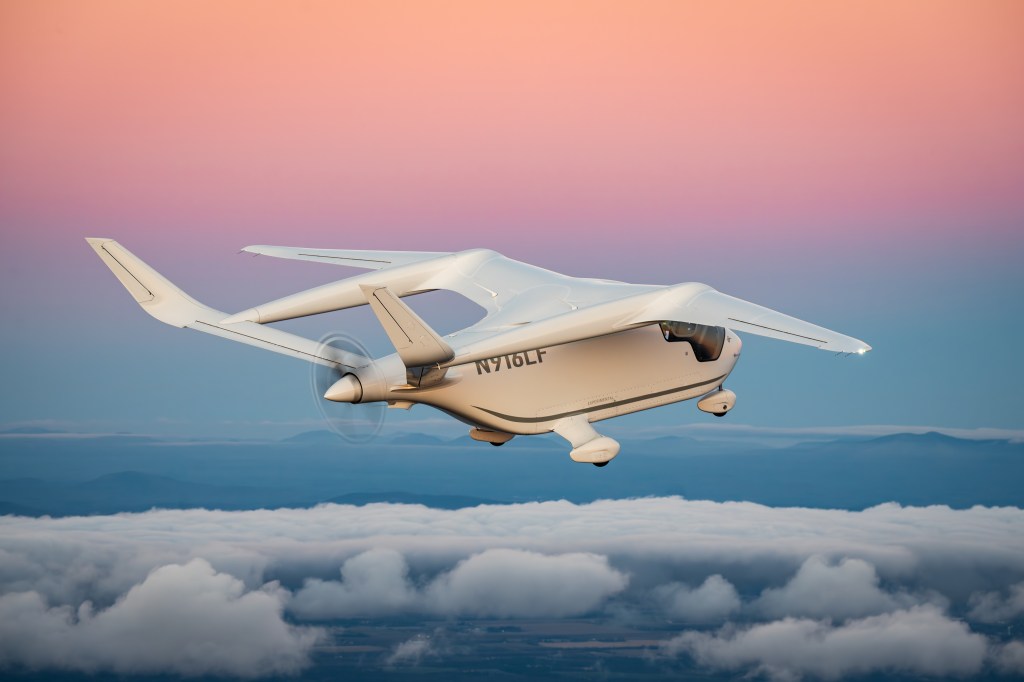
Comes in two varieties, vertical take-off and conventional flight. Good range and reasonable recharging time. The conventional aircraft has been flying five people around at a cost of $18 per hour! It is visiting Europe and the UK this summer. Company website here: beta.team
Consultation on Electronic Conspicuity – Initial Technical Concept of Operations
The UK Civil Aviation Authority (CAA) is seeking views on its draft Initial Technical Concept of Operations (ConOps) for Electronic Conspicuity (EC).
EC enables aircraft to “detect and be detected” electronically, helping to reduce the risk of mid-air collisions and improve situational awareness. This ConOps sets out our proposed technical requirements, equipage standards, and operational use of EC to support the safe integration of new and existing airspace users, including uncrewed aircraft systems (UAS), in the UK’s airspace.
This consultation invites feedback on each of the nine proposed policy positions described in the ConOps. We are seeking input from a wide range of stakeholders, including:
- General Aviation (GA) pilots and organisations
- Unmanned Aircraft operators
- Air Navigation Service Provider (ANSP)
- Aerodrome operators
- Manufacturers and developers of EC technology
- Government departments, regulators, and policy stakeholders
- Any individual or organisation with an interest in UK airspace
https://consultations.caa.co.uk/safety-and-airspace-regulation-group/ec-conops/ Closes 6 Oct 2025
CAA Announce Cost Sharing Changes Coming into Force 1 October
They really amount to clarification and regularisation of the rules. Details here: Cost sharing flights
The Mysteries of Two-stroke Carburation
I hope there is a special corner of Hell reserved for the writers of carburetor manuals, or at least for their editors who fail to do their work properly! Maybe not just carburetor manuals; the case in point that inspired this statement. Whilst in principle all required information may be contained in them (though not necessarily), if the writer assumes expert knowledge (and after-all they are the expert) lesser mortals may flounder when trying to interpret them. Take for example the ‘Mikuni VM Carburetor Super Tuning Manual’; not a random choice, I’m struggling to apply its arcane content to the twin carbs in my SD-1. Here are some of its flaws: inconsistency – where the same thing is referred to by different names, inadequate diagrams – using blueprints of the actual component (presented at an impossible to view small scale) when a schematic diagram would be more appropriate; mixing description of general principles with specific instructions, elliptical statements that require expert knowledge to understand. Argh!!!
One of the other pilots at the strip where my SD-1 lives suggested that the engine sounded a bit lean at idle when I was on short final. I discovered through experience that the idle RPM for smooth operation on the ground (about 1400 RPM) is too high when you are attempting to flare (had to turn off the ignition to land). In discussion with the previous owner I learned he made the same journey of discovery. So the idle at fully pulled throttle has to be a good bit lower, and as soon as landed the throttle must be advanced to smooth out the running of the engine. When operating at flying RPM, typically between 2500 – max 6000 RPM, optimal cruise 83 kts at 5200 RPM, EGT and CHT are as expected, and the plugs show no sign of running lean. So if adjustment is needed, it involves setting the carb air screw that (I eventually worked out) mostly affects the carb at idle.
The Hirth F23 two-stroke engine has twin Mikoni VM carburetors which complicates setting up a bit. First step was to balance the two carbs. I used a Dellorto Weber Synchrometer Carb Balancer, and that had made a slight improvement. However after my last flight while idling before shut down, the engine was running faster than I had set it. Before doing anything else I thought I should check the balance, and it was way out! The right carb was sucking off the scale, while the left was where I had previously set it. Looking in the carbs, the left one had the piston valve seated at the bottom of the bore, while the right one was about 1 mm higher. The issue seems to be the cable to the right carb. When the adjuster at the throttle lever is slackened off, there was slack in the left cable, but the right remains taught. Somehow the right cable has shortened. My suspicion was that the cable nipple in the carb has become dislodged.
Sorting this out was ‘interesting’. The cable from the throttle lever goes in to a cable splitter with three outputs, one each to the carbs and one to the oil pump. Oil is not premixed in the fuel, but metered into the fuel flow mixture downstream of the carbs, the quantity being determined by engine RPM driving the pump and throttle setting. It is supposed to eliminate the issue of lack of lubrication at low RPM.
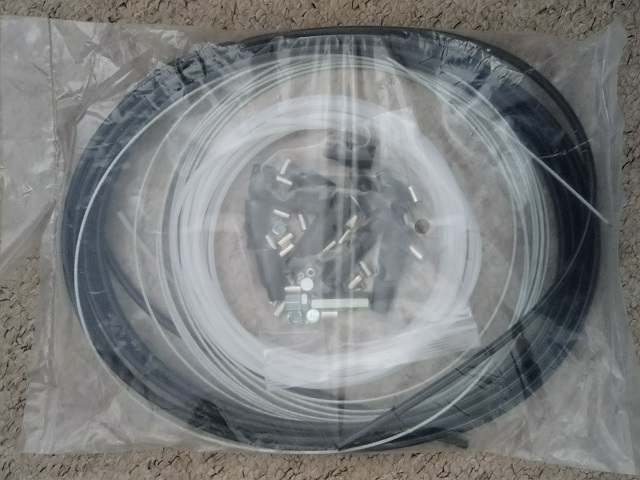
The cables enter the carbs via a right-angle bent tube adjuster. The cables had been cut the the absolute minimum length, causing the angle they entered the adjuster to be rather acute. I was a bit suspicious that they would wear at that point, but on the principle of ‘aint broke, don’t fix’ I left them. Maybe that was the cause, so replacing the cables was in order. I eBayed a cable kit. It came as a five meter length, so I have more than a lifetimes supply.
Detaching the cables from the carbs was a bit of a performance. The bent adjuster is screwed into the carb cap, so the cable has to be rotated to get it off. To do that, the cables have to be detached from the cable splitter – not something I was familiar with. Once the wire locking was off all ends of the cables, it came apart easily. Finally getting in to the carb, there was the culprit, the nipple had become unseated. (Circled in red below.)
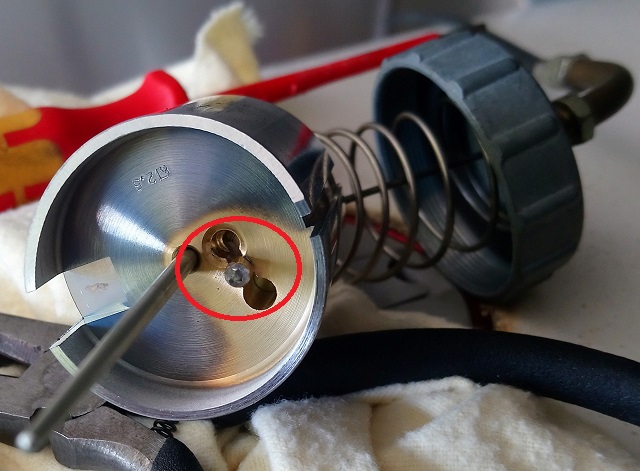
Getting the cable out of the carb, and then back in without the spring firing the components off requires a bit of manual dexterity. Thanks to a YouTube on cleaning Mikunis I was prepared.
I cut the cables one centimeter longer than the originals and they are now with without the acute bend. Fitting them into the splitter requires fighting the springs in both carbs and the oil pump and my fingers weren’t up to it. Here is my tip: use a thick matchstick as a temporary prop to hold the bits apart.
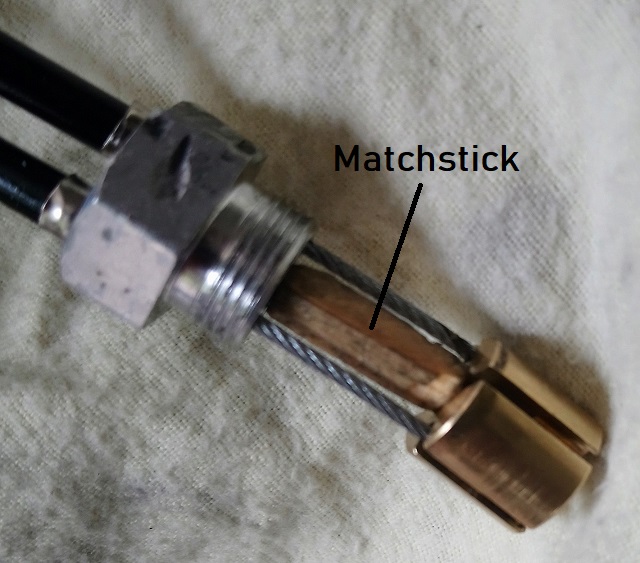
So, what caused the problem in the first place? It was my lack of understanding the mechanics of the carburetor. After setting the idle adjusting screw, I should also have set the cable adjusters to take up any slack in the outer casing despite it only being a tiny difference in length. The thing is on the Mikuni carb, this is all hidden. On carbs where the cable operates an external lever, it is unlikely to be missed. Now I know!
Richard Griffiths
Bees bothering your pitot tube?
The CAA has issued a safety bulletin about it. Download the pdf here: caa.co.uk/publication/download/25561
Manston International Airshow Postponed to Next Year!
The airshow planned for this month has been postponed. Discussions with the CAA over safety concerns took longer than expected, leaving insufficient time to put measures in place. The owners of the airfield, RiverOak Strategic Partnership, remain committed to supporting the airshow next year. It is now planned for 6th and 7th June 2026.
Car Share to the LAA Leicester Rally
If you are planning on driving to the LAA Rally at Leicester Airfield from 29th-31st August 2025 and would like to share the journey, put your details in the form below and we can link up drivers and passengers.


Events
Palmers Farm Fly-in
Saturday 2nd August 2025. See details above.
Next Strut ‘Club Night’
At The Longshore is on Wednesday 6th August, 7:30 pm.
For a full list of events go to the website Events page.
 Light Aircraft Association Southern Strut